
Reviewed by Iryna Mozghovenko, Advanced Nail Technologist (MediNail) · Updated November 2026
Short answer: most black toenails are a bruise — blood trapped under the nail after you hit your toe, or after long runs in tight shoes. It usually hurts for a few days, and then the dark spot slowly grows out with the nail, which can take 6 to 9 months. See a doctor if you don’t remember an injury, if the dark color is a stripe that gets wider, or if the color spreads to the skin around the nail. These can be signs of nail melanoma, which is rare but serious.
- Most common cause
- A bruise under the nail (doctors call it a subungual hematoma) after an injury or tight shoes
- How long it lasts
- Pain usually eases in a few days; the color can take 6–9 months to grow out
- Runners
- Usually the 2nd or 3rd toenail (“runner’s toe”)
- See a doctor if
- No injury you remember, a widening stripe, dark skin next to the nail, worsening pain, or signs of infection
30-Second Check
- You hit or stubbed your toe, or ran a long way in tight shoes, and the nail turned dark within hours — most likely a bruise. See cause 1 and 2.
- The color started at the tip, and the nail is also thick, crumbly or lifting — it may be nail fungus. See cause 3.
- The color is greenish-black — it may be a bacterial infection. See cause 4.
- It is a brown or black stripe along the nail, and you don’t remember an injury — have it checked by a dermatologist. See causes 5 and 6.
- The skin next to the nail has turned dark too — see a doctor soon.
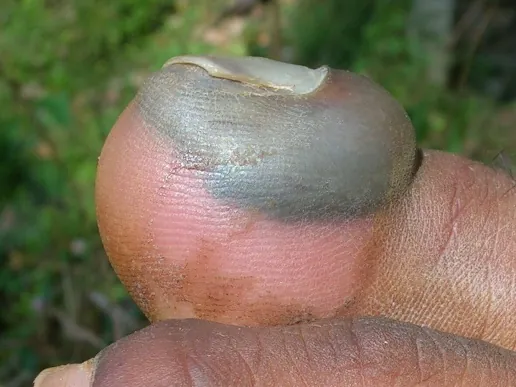
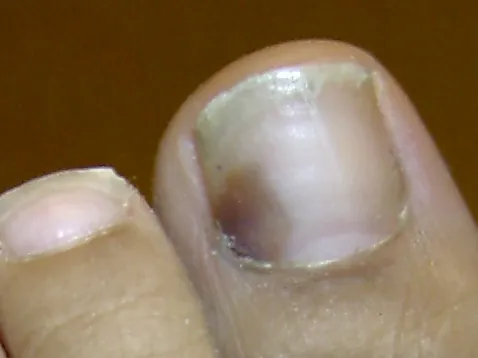
Example photos for illustration, not our clients.
The 6 Causes of a Black Toenail
- A bruise from an injury. Something heavy falls on your toe, or you stub it hard. Blood collects under the nail, and the nail turns black, purple or dark red. It often throbs and hurts to touch at first. According to Cleveland Clinic, the pain usually eases within a few days, and the dark color slowly grows out as the nail grows — this can take 6 to 9 months.
- Runner’s toe (pressure again and again). On long runs, hikes or in shoes that are too tight or too big, the toe keeps hitting the front of the shoe. The nail gets pinched, and blood collects under it. It usually affects the 2nd or 3rd toenail. A nail that is a little too long makes it more likely.
- Nail fungus. Fungus usually turns nails yellow, brown or white, but the American Academy of Dermatology says it can also make them orange, greenish-black or black. In darker skin tones, a thick fungal nail often looks brown. The color usually starts at the tip, and the nail is often thick, crumbly or lifting. More on this in our yellow toenails guide.
- A bacterial infection. According to Mayo Clinic, nail color caused by bacteria tends to be green or black. It often shows up under a nail that has lifted away from the skin.
- A harmless pigment stripe (melanonychia). A brown or black line in the nail. Cleveland Clinic notes it is most common in people with medium to dark skin tones. It can come from a mole in the nail, repeated pressure, some medicines (such as chemotherapy) or pregnancy. Even so, a new stripe should be checked by a doctor, because it can look like melanoma.
- Nail melanoma (rare). A type of skin cancer that grows under the nail. It makes up only 0.7% to 3.5% of all melanomas and most often affects the big toe, thumb or index finger. Warning signs: a brown or black stripe, especially one that gets wider or has uneven color; dark color on the skin next to the nail; a nail that splits or lifts; a bump under the nail; or bleeding. When it is caught early, it is highly treatable.
Bruise or Something Else? How to Tell
| Usually a bruise | Have a doctor check it | |
|---|---|---|
| When it appeared | Within hours of an injury or a long run | No injury you remember, or it came on slowly |
| What it looks like | A dark patch or blob | A brown or black stripe along the nail |
| Over time | Slowly moves toward the tip and grows out | Stays, gets wider, or gets darker |
| Skin around the nail | Normal | Dark color on the skin next to the nail |
| Pain | Hurts at first, then eases within days | Pain that gets worse, swelling, pus or fever |
A simple tip: take a photo of the nail today. A bruise slowly moves toward the tip as the nail grows. A stripe that starts at the base of the nail and does not move, or gets wider, needs a doctor.
What To Do at Home
- Ice. Wrap ice in a soft cloth and hold it on the toe to ease swelling and pain.
- Keep it clean and dry.
- Give the toe room. Wear shoes that don’t press on it.
- Don’t drill, poke or drain the nail yourself. Cleveland Clinic warns never to drain blood under a nail at home. If the pressure is very painful, a doctor can release it with a simple procedure.
- Don’t hide a new dark spot under polish. You need to see how it changes.
When to See a Doctor
- strong, throbbing pain, or pain that gets worse over the next few hours;
- a deep cut, bleeding that won’t stop, or a toe that might be broken;
- redness, swelling, warmth, pus or fever;
- the nail turned dark and you don’t remember any injury;
- a brown or black stripe that is new, gets wider or darker, or has uneven color; dark skin next to the nail; a nail that splits; or a bump under the nail — see a board-certified dermatologist;
- you have diabetes or poor blood flow in your feet.
The American College of Foot and Ankle Surgeons advises having every black toenail checked by a foot and ankle surgeon at least once, to rule out melanoma. Most of the time it turns out to be a bruise — but it is worth being sure.
What We Can Do in the Studio
We are a cosmetic foot-care studio. We don’t diagnose nails and we don’t drain them. But once the pain has gone and nothing needs a doctor, we can help the nail look and feel better while it grows out:
- Trim and thin a damaged nail. We gently reshape a dark, thick or damaged nail so it stops catching on socks and shoes. This is part of our Medi Pedicure.
- Nail care for runners. Correct nail length and shape help prevent black toenails. See our men’s and runners’ pedicure.
- Fungal nails. Painless cosmetic thinning of thick, fungus-damaged nails helps your treatment reach the nail bed. See our toenail fungus solution.
If we see a stripe or anything unusual, we will tell you directly and recommend a doctor before any cosmetic work.
How to Prevent Runner’s Toe
- Wear shoes that fit well — not too tight and not too big, with room for your toes.
- Trim toenails straight across, and don’t let them get too long.
- Wear closed shoes, not sandals or bare feet, when you move heavy things.
Frequently Asked Questions
Will a black toenail go away on its own?
Should I drain a black toenail at home?
Will my black toenail fall off?
Can toenail fungus make a toenail black?
How do I know if a black toenail is melanoma?
Can I get a pedicure with a black toenail?
Sources
- American Academy of Dermatology (AAD): How to check your nails for melanoma
- American Academy of Dermatology (AAD): Nail fungus: signs and symptoms
- Cleveland Clinic: Subungual hematoma (bleeding and bruising under the nail)
- Cleveland Clinic: Subungual melanoma (nail melanoma)
- Cleveland Clinic: Melanonychia
- American College of Foot and Ankle Surgeons (FootHealthFacts): Black toenails
- Mayo Clinic: Nail fungus: symptoms and causes
Related
About this guide. Written by the team at MedPedicure Center, a waterless foot-care studio in Rockville Town Square, Rockville, MD, and reviewed by our founder, Iryna Mozghovenko, a licensed nail specialist with more than 10 years of experience. Her training includes a 1,000-hour podology course (2015), podology training in the Dieter Baumann method (2019) and the MediNail Learning Center Advanced Nail Technologist program (2024). See her training and certificates. We provide cosmetic foot care, not medical treatment.
In Rockville or the DC area? Book a nail check
For a dark nail after an injury, a thick or fungal nail, or runner’s toe care. If anything looks like it needs a doctor, we will tell you. Most appointments are available within 1–2 weeks.
MedPedicure Center provides cosmetic foot care and does not diagnose, treat or cure medical conditions. This page is general information, not medical advice. For pain, infection, wounds, a new or changing dark stripe in a nail, or any condition that may need medical care, please consult a licensed podiatrist, dermatologist or physician.