
Ingrown Toenail Correction & Toenail Braces in Rockville, MD
Painless correction of ingrown and curved toenails with nail braces — no surgery, no shots. Our studio is in Rockville Town Square, a 4-minute walk from the Rockville Metro (Red Line).
A Safe Alternative to Ingrown Toenail Surgery
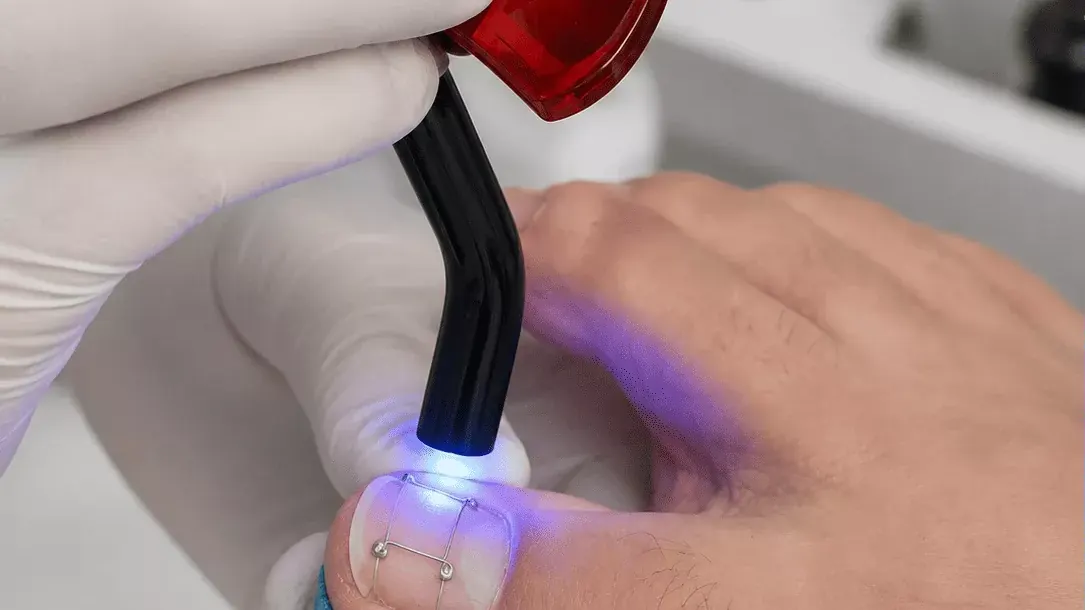
If you have strongly curved or ingrown toenails, surgery is no longer your only option. Toenail bracing works like braces for teeth: a small brace is attached across the nail. It gently lifts the edges and takes pressure off the skin around the nail.
Putting on the brace doesn't hurt, needs no numbing shots, and has no recovery time. The nail is corrected slowly over several months: the brace safely reshapes it and helps it grow the right way. We offer several systems — Titanium Thread, Unibrace, Frezera, and B/S Systems — so we can choose the best one for your nail's thickness and how curved it is.
What Is an Ingrown Toenail?
An ingrown toenail (the medical name is onychocryptosis) happens when the edge or corner of a toenail grows into the skin instead of straight forward. It most often affects the big toe. It causes pain, redness, swelling, and sometimes infection.
A curved (involuted) toenail is a close relative: the nail itself is too curved, like a pincer, and presses into the skin on the sides even before it cuts in. Both problems respond very well to bracing, because bracing fixes the real cause: the nail's wrong shape.
Typical symptoms include:
- • Sharp pain at the edge of the toenail, especially with shoe pressure
- • Redness and swelling along the side of the nail
- • Tender, hardened skin around the nail edge
- • Recurring infection or pus discharge
- • Visibly curved or pincer-shaped nail plate
Common causes: cutting toenails wrong (corners too short or too round), tight shoes, repeated hits from running or hiking, a nail shape you were born with, fungus that makes the nail thick and grow crooked, and regrowth after earlier nail surgery.
Not sure if a pedicure is safe for your toe right now? See can you get a pedicure with an ingrown toenail. For strongly curved nails, read about curved (pincer) toenails.
Why Choose Toenail Bracing?
- No surgery, no needles: a gentle alternative to removing the ingrown nail, with no cutting and no numbing shots.
- Immediate relief: pressure and pain drop noticeably right after the brace is put on.
- Zero downtime: wear your normal shoes and go on with your day right away.
- Long-term realignment: teaches the nail to grow flatter, so the problem is less likely to come back.
The Application Process

Structural Assessment
We check the thickness, shape, and length of the nail and the skin around it. Then we choose the brace that will work best for your nail.
Preparation & Custom Application
We clean and prepare the nail. The chosen brace (for example, Titanium Thread or Unibrace) is fitted to your nail and firmly attached. It works like a spring right away, lifting the nail edges.
Gradual Correction & Reinstallation
As the nail grows, the brace moves with it. Over several weeks, the nail straightens. From time to time we replace the brace to keep the right tension until the correction is done.
The Four Bracing Systems We Offer
Different ingrown toenails need different braces. Here is how each of the four systems works and which case it suits best.
B/S System (Plastic)
From $70A thin, clear strip reinforced with fiberglass, attached to the top of the nail. Best for mild to moderate curving on healthy nails, for athletes, and for anyone who wants the brace to be invisible. The quickest and most affordable option.
Titanium Thread
$150A flexible titanium wire attached across the nail with a strong resin. Ideal for thicker nails, ridged nails, and cases where the B/S system would not be strong enough. Holds the correction firmly and still feels comfortable in closed shoes.
Unibrace
$250A precise metal brace hooked under both side edges of the nail and tightened across the top. Best for severely curved (pincer) nails that need a strong lift right away. Can be reused with follow-up adjustments.
Frezera
$250A modern Italian system: a custom-shaped spring wire with resin anchors. Excellent for hard cases where other methods failed, for nails growing back after surgery, and for athletes whose nails take a lot of pressure.
We check your nail at the start of the visit and recommend the right system. You don't need to choose in advance — we will explain the options that fit your case.
Toenail Bracing vs Ingrown Toenail Surgery
Many people come to us after being told surgery is their only option (removing part of the nail or the nail root). Here is an honest comparison to help you decide.
| Factor | Toenail Bracing | Surgical Removal |
|---|---|---|
| Anesthesia required | None | Local injection |
| Pain during procedure | None | Numbed during, sore after |
| Downtime | None — walk out, wear normal shoes | 1–2 weeks limited activity |
| Nail loss | No — the nail is preserved | Partial or full nail removed |
| Time to relief | Noticeable relief right away, full correction in months | Days for healing, weeks for regrowth |
| Recurrence risk | Low if correction held to completion | Possible regrowth in distorted shape |
| Best for | Most non-infected curved & ingrown nails | Acute infection, severe damage, failed bracing |
Bracing is usually the better first step: no cutting, no recovery time, and you keep your nail. Surgery makes sense when there is a strong infection, severe nail damage, or when bracing didn't work. If you're not sure which fits your case, we'll tell you honestly during the check.
When You Should See a Podiatrist Instead
Our bracing service is cosmetic, not medical. In some cases, you should see a licensed podiatrist or doctor before a bracing visit:
- Active infection — pus, strong redness, fever, or red lines moving up the foot.
- Diabetes, nerve damage in the feet (neuropathy), or poor blood flow.
- Pain so severe you cannot bear weight on the foot.
- Granulation tissue (a red, fleshy lump) growing next to the nail.
- Children under 12, or anyone who has already had several failed bracing or surgery attempts.
For mild to moderate curving or ingrown nails that keep coming back without a strong infection, bracing is usually the right first step.
Related Foot Care Services
Ingrown nails often come with other foot problems. These services may also help:
Medi Pedicure (Specialized Foot Care)
For thick nails, painful calluses, and other foot problems that often come with ingrown nails.
Toenail Fungus Solution
Fungus often makes nails thick and crooked, which can lead to ingrown nails. Cosmetic nail thinning works well together with bracing.
Initial Consultation
Not sure if bracing is right for you? Start with a nail check and a care plan made for you.
Wellness Pedicure
A waterless pedicure for regular care with correct nail trimming — the key to keeping ingrown nails from coming back.
Three Typical Bracing Cases
These are combined examples based on typical clients. Details are changed — no real names or personal information.
"Third recurrence in two years"
Right big toenail. The ingrown edge kept coming back even after two podiatrist visits where part of the nail edge was removed. The reason was clear: the nail's shape kept causing the problem. The client came to try a correction without surgery.
Path: a composite brace was put on at the first visit and replaced at week 6. By month 4, the nail edge had grown out straight for the first time in years. No surgery scar, no downtime. The client came back at month 6 for a final check; no more bracing needed.
"My podiatrist wanted to avoid surgery"
A long-lasting ingrown big toenail on the left foot. She has well-controlled diabetes. Her podiatrist wanted to avoid any surgical cut because wounds heal slower with diabetes, so she was referred to us for bracing as the first step.
Path: a 3TO wire brace, replaced once. We planned her visits around her endocrinologist's check-ups. By month 5, the nail had changed shape enough; no surgery needed.
"It came back six months after the surgery"
This client had part of the nail removed 9 months earlier. The ingrown edge came back as the nail grew, because the nail's shape was never corrected — only the symptom was cut away. The client did not want another surgery.
Path: a COMBIped composite brace was put on while the nail was still growing back. The nail was reshaped as it grew, so the new nail came in straight from the start. One brace cycle was enough.
Frequently Asked Questions
Does toenail bracing hurt?
Do toenail braces work?
How long does it take to fix an ingrown toenail with braces?
Can you fix an ingrown toenail without surgery?
Can a nail salon safely remove ingrown toenails?
Which brace system is best for me?
How much does ingrown toenail correction cost in Rockville?
Can I wear normal shoes with a brace on?
Do you serve clients from Baltimore?
*Disclaimer: MedPedicure Center provides cosmetic foot care and aesthetic restoration services. We do not diagnose, treat, or cure medical conditions. Toenail bracing is a non-invasive cosmetic correction technique; it is not a medical procedure. Clinical terms used on this page are for general informational context only. For acute bacterial infection, severe pain, diabetic complications, or any condition that may require medical intervention, please consult a licensed podiatrist or physician before booking.
Brace Options & Pricing
We help you choose the right brace at the start of your visit.